
If your workouts feel random, your results probably do too.
One day it’s cardio, another day it’s abs.
Then maybe a full-body class when you have time.
And while you’re still “working out,” you’re not seeing the changes you want.
The missing piece isn’t effort → it’s structure.
If your goal is fat loss and lean muscle, your weekly workout plan needs to be intentional, balanced, and repeatable. Sometimes the simpler, the better.
Let’s break down exactly how to structure your week so your workouts actually work.
Structure > Motivation
Motivation comes and goes, but structure keeps you consistent.
When your workouts are planned in advance:
You remove decision fatigue
You train each muscle group effectively
You allow proper recovery
You avoid overtraining or undertraining
This is what leads to visible and desirable results.
The Goal = Fat Loss + Lean Muscle
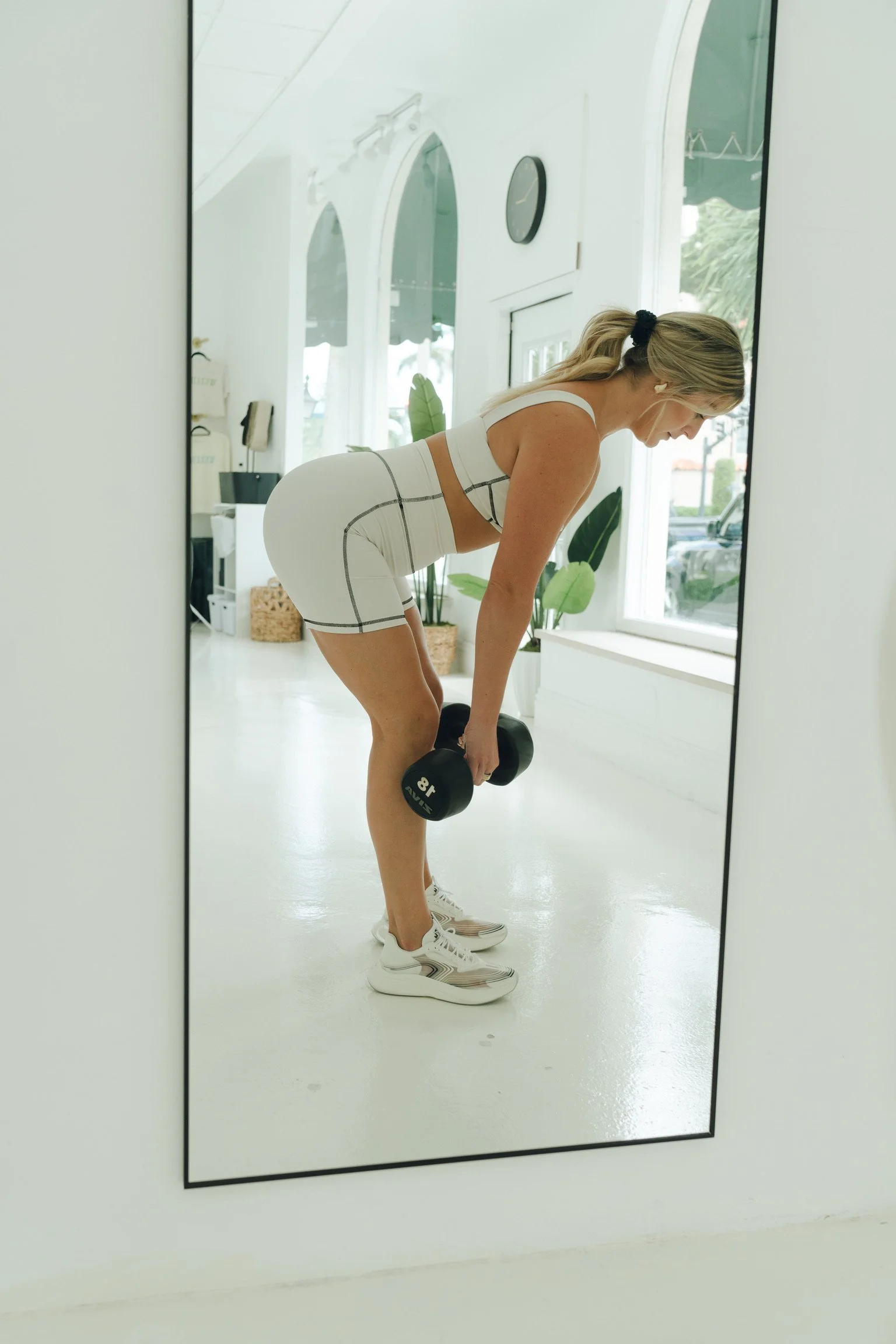
To achieve both, your plan needs to include:
Strength training → foundation
Cardio → supporting role
Daily movement → baseline activity
Recovery → non-negotiable
Most people either overdo cardio or under-train strength.
We’re going to fix that.
The Ideal Weekly Workout Structure
Here’s a simple and effective structure that works for most busy women:
4-Day Strength + Movement Plan
Day 1 – Lower Body (Glutes & Legs)
Day 2 – Upper Body (Back, Shoulders, Arms)
Day 3 – Active Recovery (Walking or Mobility)
Day 4 – Lower Body (Glute Focus)
Day 5 – Upper Body (Push + Core)
Weekend – Light Movement or Rest
This structure trains each muscle group twice per week, supports muscle growth, allows recovery and fits into your busy schedule.
All you need to do is make the time for it.
The Secret Sauce
To build lean muscle and support fat loss, your workouts should focus on compound movements → simultaneously engaging multiple joints and working several major muscle groups in a single, coordinated action
Lower Body
Squats:
quads, glutes, hamstrings and calves
Romanian deadlifts:
hamstrings, glutes and lower back
Hip thrusts:
glutes, hamstrings and core
Lunges:
quads, glutes and hamstrings
Upper Body
Shoulder presses:
deltoids, triceps and upper pectorals
Rows:
latissimus dorsi (lats), rhomboids, traps and biceps
Lat pulldowns:
latissimus dorsi (lats), biceps, rear deltoids and rhomboids
Push-ups or bench press:
pectorals, anterior deltoids and triceps
These exercises give you the most results in the least amount of time.
A few of my favorite fitness, recovery and wellness essentials that help make consistency easier are linked here.
How Long Should Workouts Be?

You don’t need 2-hour gym sessions.
Most effective workouts are 40–50 minutes
That’s enough time to warm up → lift with intention → focus on form → progress over time
Consistency beats long, inconsistent workouts.
If you’re unsure what to eat before strength training, how to support recovery after workouts or how to fuel your body without overcomplicating nutrition, this guide breaks it down in a simple and realistic way.
Read next: What to Eat Before & After Your Workout for Lean Muscle & Energy
Where Cardio Comes In
Cardio supports fat loss, but it shouldn’t be the main focus.
Instead of daily intense cardio, aim for:
1–2 cardio sessions per week, or
Daily walking (7,000–10,000 steps)
Cardio should complement strength training—not replace it.
Progressive Overload
Progressive Overload → gradually increasing the intensity, volume, or frequency of training to continuously challenge the muscular system and prevent plateaus
Basically, doing the same weights every week won’t change your body.
To build lean muscle, your body needs a reason to adapt which is why we track progress by using progressive overload.
You can progress by:
Increasing weight → even a few pounds makes a difference
Adding reps → the last two reps should feel challenging
Improving form → focusing on what muscles should be engaging
Slowing tempo → slow count on the “way down”
Small improvements each week lead to big results over time.
Recovery: The Most Overlooked Piece
More workouts don’t always mean better results.
Muscle is built during recovery, not during the workout itself.
Make sure you:
Take at least 1–2 rest or active recovery days
Get enough sleep, 8 hours is ideal
Avoid training the same muscle group every day
Recovery supports fat loss, hormone balance, and performance.
Nutrition Still Drives Results

Your workout plan sets the stimulus.
Your nutrition supports the outcome.
To support fat loss and muscle:
Protein
Aim for about 0.8–1 gram per pound of body weight daily
Balanced meals
Protein
Fiber
Healthy fats
Carbohydrates
Carbs are especially important for fueling strength workouts.
In Real Life Weekly Example
Here’s what it looks like in real life:
Monday: Lower Body
Tuesday: Upper Body
Wednesday: Walk + Stretch
Thursday: Lower Body
Friday: Upper Body + Core
Saturday: Walk or Light Cardio
Sunday: Rest
This is simple, repeatable, and effective.
Signs Your Workout Plan Is Working
You don’t need to rely only on the scale.
Look for:
Increased strength
Consistent energy levels
Improved muscle tone
Clothes fitting differently, in a good way
More confidence in your body
These are real indicators of progress.
Common Mistakes to Avoid
Doing only cardio
Changing workouts too often
Not lifting heavy enough
Skipping rest days
Under-eating, especially protein
Avoiding these mistakes can dramatically improve results.
Frequently Asked Questions (faqs):
1. How many days per week should women work out?
Most women see great results with 3–4 strength workouts per week, combined with daily movement.
2. Can I lose fat without strength training?
You can lose weight, but without strength training, you may lose muscle and struggle with body composition.
3. Should I work out every day?
No. Recovery is essential. Rest or active recovery days improve long-term results.
4. What if I only have 3 days per week?
A full-body workout 3 times per week is highly effective when done consistently.
5. How long before I see results?
Many women notice strength and energy improvements within a few weeks. Visible changes typically appear after 6–8 weeks.
Get The WELLTHY 7-Day Fat Loss Training Split inside Substack, designed to help women build lean muscle, burn fat and create a balanced workout routine that actually fits into real life. This training split gives you a structured yet sustainable approach to strength training, recovery, and movement so you can stay consistent, improve your energy and build a stronger, healthier body without extreme workouts or burnout.